
INDEPENDENT FOOTBALL WRITINGNORTH OF SCOTLAND
The North Touchline

There is more to watch
than the ball.

Runs away from the ball. The paper programme in a coat pocket. A first visit to a ground. Notes on the small things that make football worth watching.

A programme catalogue sheet →

Looking for the official club website?

Independent publication. For club matters: Formartine United FC’s official website.

Watching the game

The space around a throw-in: a touchline notebook

A throw-in offers a short pause in which the shape around the ball is unusually visible. Several players may offer a route into the pitch, yet only one receives the throw. The useful question for a spectator is not simply whether possession was kept. It is what options were visible before the restart, and what changed as the ball travelled.

Choose one throw-in and follow it through the first two touches. This is an observation exercise, not a report of a particular fixture. The example below uses invented players and positions; it makes no claim about a club’s instructions.

Start with a small patch of pitch

Mark the thrower as T on a sketch of the touchline. Add the nearest available teammate, N, and a second teammate farther inside, I. Mark a nearby opponent as D. You do not need every player on the pitch. You do need to know which direction the throwing team is attacking and which side of the sketch is the field.

Write “approximate positions” beside the drawing. A spectator’s angle is not tracking data. Players can appear close together while being separated along the length of the pitch, and bodies can hide a passing route. Leave a gap in the note if you cannot see the receiver’s first touch.

Keep rules and observations distinct. IFAB’s Law 15 says opponents must remain at least two metres from the point on the touchline where the throw-in is taken, and the ball becomes live when it enters the field. Your sketch is not a reliable measurement of that distance or a substitute for the referee’s decision.

Record three moments

  1. Before release: who is visibly available, who is moving, and which view is obstructed?
  2. As the ball travels: which teammate receives it, and does the nearest opponent move with that player or stay in place?
  3. After the next touch: does the receiver return the ball, turn, play inside, move along the line or lose possession? Record only what you can see.

These three moments give your note a beginning and an end. They also prevent the outcome from rewriting the setup. A pass that eventually goes astray does not establish that the first receiving option was poor; a successful move does not prove that every earlier decision was planned.

A worked passage

Imagine N moving a few steps towards T while I holds a position farther inside. D follows N. T throws to N, who returns the ball to T with the next touch. T then passes inside. The near movement, return and inside pass are the visible sequence in this invented passage.

Notebook: N moved towards the thrower; D moved with N. N received and returned the ball. The next pass went inside. My view did not show whether I was available before N moved.

A possible explanation is that the short exchange helped create an inside route. Another is that the inside route was available already and the return merely made it easier to use. Without the earlier view, you cannot choose confidently between them. “The routine drew the defender out” would claim a cause that the note has not established.

Change one feature in the comparison

Look for another throw-in in roughly the same area. This time, suppose D holds position instead of following N. Record what the receiver does next. Do not require the two passages to end alike. The comparison is useful because one visible relationship differs, not because it produces a verdict on a team.

Also note differences that make comparison weaker: a different receiver, pressure arriving from behind, a throw taken quickly, or a view from the other side. “Same area” is a starting point, not proof of identical circumstances. Two selected passages cannot tell you how often a pattern occurred throughout the match.

Give the thrower a second look

It is easy to stop watching T after the release. Follow where the thrower goes while the receiver controls the ball. Is a return route visible? Does another player occupy that space? If the thrower disappears behind a standing spectator, record that loss of view instead of completing the movement from expectation.

This complements the exercise in watching a player who does not receive the pass. Here the frame is narrower: a restart, the immediate receiving choices and the first exchange afterwards. Keep the note tied to those moments.

Finish with one sentence you could defend from your observation and one question the view could not answer. That gives a later match account a concrete passage to discuss, while leaving tactical intention, private instructions and unseen movement out of the story.
Watching the game

Watch the player who does not receive the pass

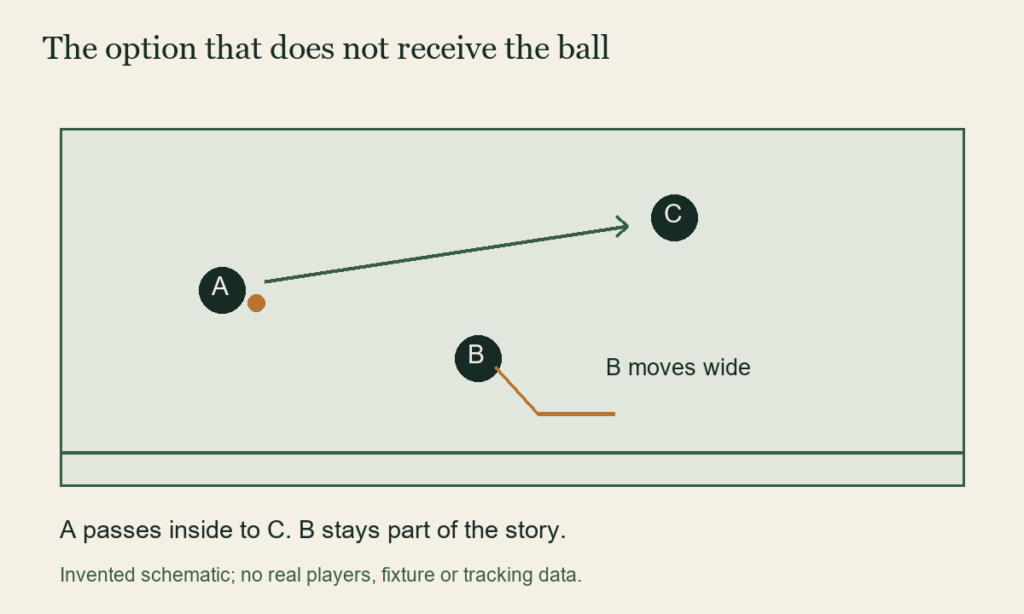
An invented diagram shows A passing inside to C while B moves towards the near touchline and does not receive the ball.

The ball gives a football match its most obvious storyline. A second story happens around it: a run that makes an option available, a defender who holds position, a teammate who moves and never receives the pass. You can give that movement proper attention without pretending to know a manager’s instructions.

This is a watching exercise, not a report of a match we attended. Its worked passage is invented. The aim is a modest one: finish with a clear description, a possible explanation and an honest account of what your view did not reveal.

What should you follow for one passage?

Choose one player away from the ball. Stay with them through a short passage rather than trying to follow the whole team. Note where they begin, what changes around them and where they finish. If you lose sight of them, record the gap. Filling it with a likely movement would turn your note into a reconstruction.

Use a fixed landmark such as the touchline to describe direction. “Moved towards the near touchline” remains understandable when a sketch is turned around. “Moved right” needs an explanation of whose right you mean. An approximate distance is enough if you cannot measure it; do not add a precise number just because a diagram has neat lines.

What does the invented example actually show?

Imagine a short passage with three teammates: A has the ball, B begins between A and the near touchline, and C waits farther inside. D is a nearby defender. The sketch shows their positions schematically; it is not to scale and does not come from tracking data or a real fixture.

Three invented moments: A holds the ball with B nearby; B moves towards the near touchline while defender D stays; A passes inside to C and B does not receive it.
An invented passage, viewed from the near touchline. Solid line: pass. Broken line: movement. Positions are schematic, not measured.
A small observation record for the invented passage
Moment Visible in the model Still unknown
Start A has the ball. B is nearer the touchline; C is inside. What options A can see from pitch level.
Movement B moves nearer the touchline. D stays in place in this sketch. Whether D is watching B or following another instruction.
Pass A passes to C. B does not receive the ball. Whether B’s movement influenced A’s decision.

The description supports “B moved wide before the inside pass”. It does not establish “B was ordered to create the pass” or “D ignored the run”. Those sentences introduce instructions, attention and causation that the model does not supply. B may have offered a useful option; the pass going elsewhere does not prove that the movement was pointless.

How do you keep an explanation separate?

Give your note three short lines. First, write the visible sequence in ordinary language. Second, add a possible interpretation with a word such as “may”. Third, name one observation that would help distinguish it from another explanation. The third line is what stops a plausible story hardening into a claim.

Observed: B moved towards the near touchline before A passed inside to C.

Possible reading: B may have been offering a wide option.

Open question: Was the wide passing lane open from A’s position?

A rival reading could be that B was simply returning to a preferred position after an earlier phase. Our short invented passage cannot decide. You do not need to choose a winner to make the note useful. Keeping both possibilities visible tells a later reader what further context is missing.

What changes when your view is incomplete?

From a stand or touchline, another player can hide the passing lane. The near player may look farther from the ball than they are. A recording may cut away just before the movement you want to follow. Treat these as limits on the observation, not invitations to fill the frame with confidence.

Where a recording is lawfully available, a second viewing can help. First repeat the same observation, then look at the ball carrier. Keep the two notes separate until you compare them. A replay can clarify a position while still leaving a player’s intention unknown. Do not reproduce footage or identify spectators merely to decorate a note.

When is a repeated movement worth recording?

Look for a similar situation, not just a similar run. Was possession settled or changing? Was the player starting from the same area? Could the ball carrier see the same options? A movement repeated under different conditions may answer a different problem.

For a second passage, reuse the three lines: observed, possible reading, open question. Add one sentence on what changed between passages. Avoid turning two examples into a frequency claim about a whole match. If you want to say “often”, you need a defined stretch of play and a record of the other occasions too.

End with one contribution you can describe and one uncertainty you kept. That is enough for a useful watching note. If it becomes part of a match account, the sequence behind the scoreline should be checked separately. A careful account can notice work away from the ball while leaving the dressing-room conversation to the people who were actually there.